
AC Installation in Laredo, TX
Installation quality has more influence on how a cooling system performs than the brand on the label. Sizing, duct condition, airflow setup, refrigerant charge and drainage all get decided during installation — and they set the ceiling for comfort and efficiency for years.
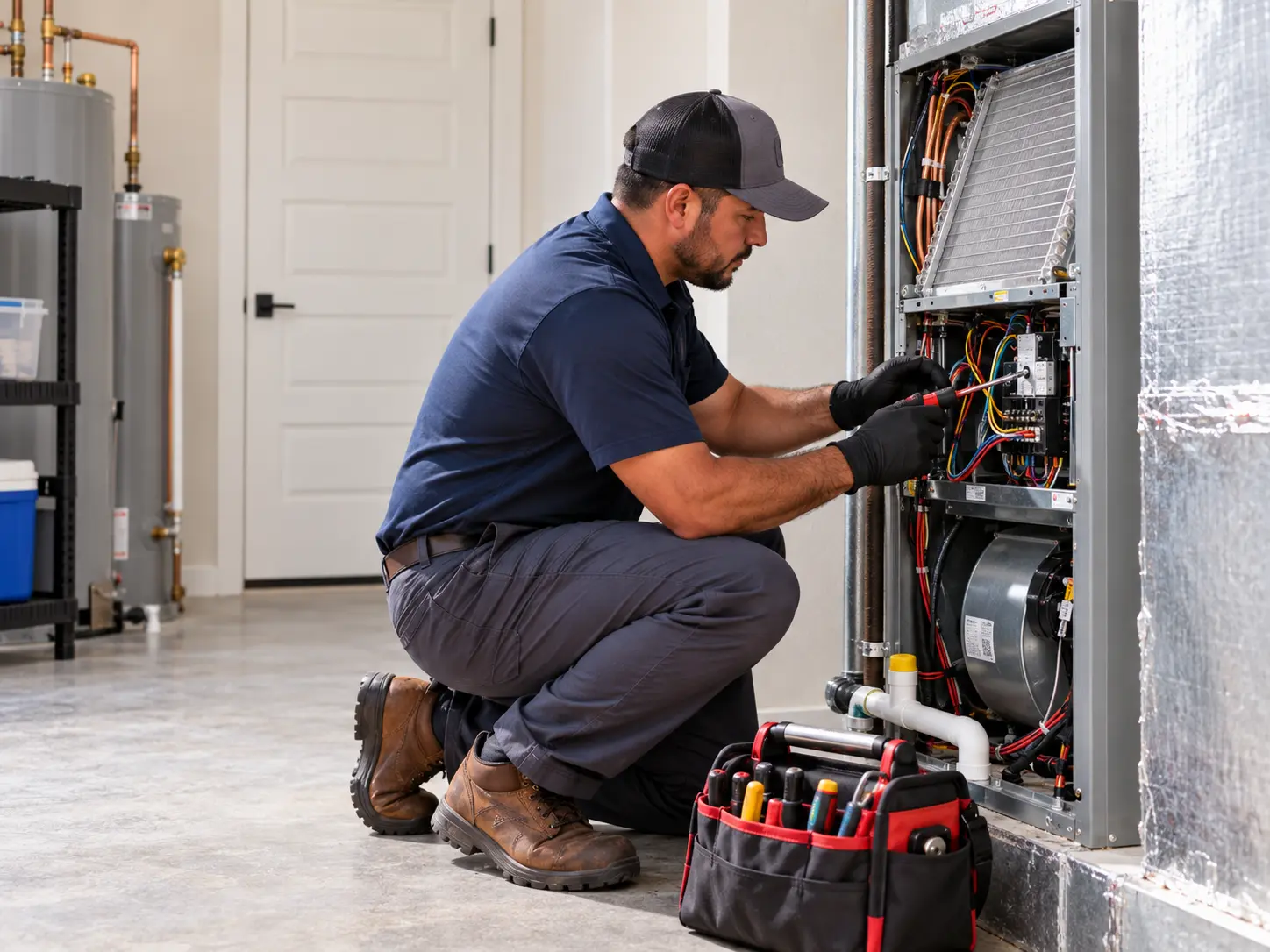
New installations happen for several reasons: a first system in a property without central cooling, a system being added during a remodel or addition, or replacement of equipment that has reached the end of its practical life.
Whatever the reason, the questions that matter are the same — how much capacity does this building actually need, can the duct system deliver it, and will the installation be commissioned with measurements rather than assumptions.
Sizing is a calculation, not a guess
Capacity should follow a load calculation that accounts for square footage, insulation, window area and orientation, ceiling height, infiltration and local design temperatures. In Laredo, high summer design temperatures make that calculation meaningful — but bigger is not automatically better.
Oversized equipment satisfies the thermostat quickly, cycles frequently and removes less moisture, which produces a house that feels cool and clammy. Undersized equipment runs continuously and loses ground in the afternoon. The goal is matching capacity to the actual load.
Ductwork decides whether capacity reaches the rooms
New equipment connected to an inadequate duct system inherits that system's limitations. If ducts are undersized, leaking into a hot attic, poorly insulated or unbalanced, comfort complaints will persist even with a brand-new condenser outside.
A thorough installation evaluation includes the distribution system: duct sizing and layout, return air capacity, sealing and insulation, and register locations. Sometimes duct corrections matter more to the outcome than the equipment choice itself.
What a careful installation includes
- A load calculation and an equipment selection that matches it.
- Evaluation of existing ductwork, return capacity and airflow.
- Proper line-set sizing, brazing, evacuation and charging to manufacturer specification.
- Correct blower and airflow setup for the installed coil.
- A condensate drain with proper slope, trap where required, and a float switch.
- Electrical work sized and connected correctly, with a serviceable disconnect.
- Thermostat compatibility and configuration for the installed equipment.
- Commissioning measurements recorded at startup — temperature split, airflow, pressures.
Equipment types to consider
- Central split system
- The most common residential setup: an outdoor condenser with an indoor coil and blower, distributing through ductwork.
- Heat pump
- Similar to a split system but able to provide heating by reversing the refrigerant cycle — often practical in a mild-winter climate.
- Mini split
- Ductless indoor units matched to an outdoor unit. Useful for additions, converted garages, casitas and rooms ductwork cannot serve well.
- Package unit
- All components in one cabinet, typically installed at grade or on a roof. Common on some homes and light commercial buildings.
Planning the project
Installation projects benefit from a site visit. Equipment location, attic and closet access, electrical capacity, line-set routing, drainage path and permit requirements all depend on the specific property.
Call (956) 663-3737 to discuss what you are trying to accomplish — a full replacement, cooling for an addition, or converting a space that has never had adequate air conditioning — and what an evaluation would involve.
Questions & answers
Frequently Asked Questions
- How is the right AC size determined?
- Through a load calculation rather than a rule of thumb. The calculation accounts for floor area, insulation levels, window area and orientation, ceiling heights, air leakage and local design conditions. Square-footage shortcuts frequently produce oversized equipment, which cycles too often, dehumidifies poorly and can leave a house cool but damp.
- Should I replace the ductwork when I install a new system?
- Not always, but it should be evaluated. If the ducts are appropriately sized, reasonably sealed and insulated, they may be fine. If they leak substantially into a hot attic, are undersized, or lack adequate return capacity, correcting them often improves comfort more than a larger unit would. An evaluation identifies which situation you are in.
- Is a heat pump a good choice in Laredo?
- Winters here are mild, which is generally favorable for heat pump heating since the equipment operates in its efficient range most of the time. Whether it makes sense for a specific property depends on the existing heating setup, electrical service, ductwork and your priorities. A site evaluation is the way to compare options honestly.
- How long does an installation take?
- It depends on scope. A straightforward equipment changeout with accessible locations is typically a shorter project than one involving duct modifications, electrical upgrades, new line-set routing or a first-time system in a home without existing ductwork. A site visit is what produces a realistic timeline for your property.
- What should I ask before agreeing to an installation?
- Ask whether a load calculation will be performed, what happens with the existing ductwork, how the system will be commissioned and what measurements will be recorded at startup, what the drainage and float switch arrangement will be, and what documentation you will receive. Those questions reveal how the installation will actually be done.
Need Help With Your AC?
Describe what your air conditioner is doing and request service for your Laredo-area property.
(956) 663-3737