Emergency AC Repair in Laredo, TX
When an air conditioner stops cooling during a Laredo heat stretch, indoor temperatures climb fast. This page explains what counts as an urgent cooling failure, what you can safely check in the first few minutes, and how to request AC service.
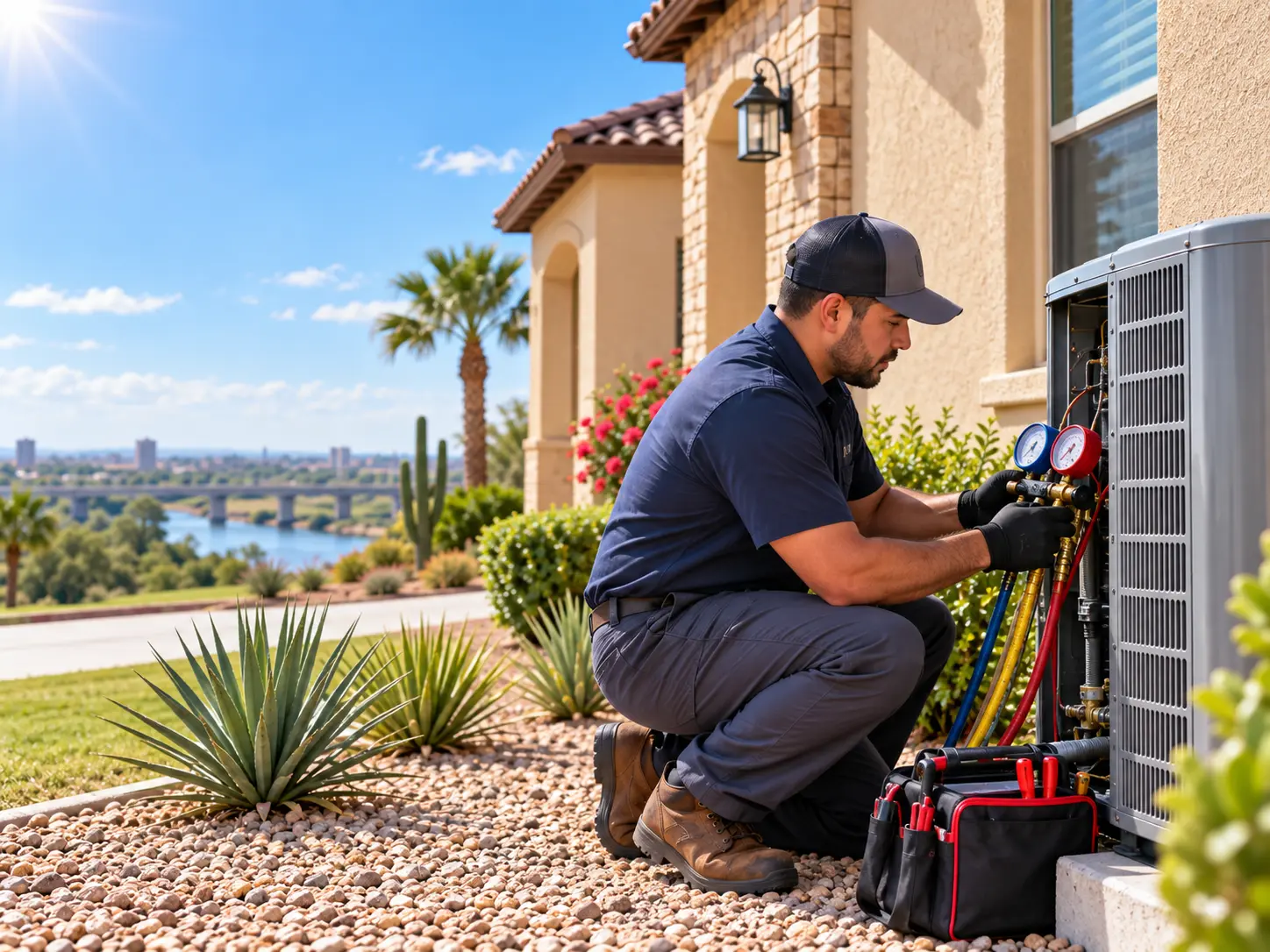
An urgent air conditioning problem is usually one of three things: the system will not run at all, it runs continuously without lowering the indoor temperature, or it is doing something that could cause damage — such as leaking water near electrical equipment or tripping a breaker.
Call (956) 663-3737 to describe the problem and discuss availability. Service availability may vary, so the fastest path is a phone conversation where the symptom, the equipment type and the property location can all be covered at once.
Symptoms that usually warrant urgent attention
Any symptom involving smoke, burning odors, sparking or standing water around electrical equipment is a reason to shut the system off at the thermostat and at the breaker before anything else.
- The system is completely off: the thermostat calls for cooling and nothing starts, indoors or outdoors.
- Indoor temperature is rising and the air from the vents is room temperature or warmer.
- The breaker serving the air conditioner trips repeatedly, or a disconnect fuse has failed.
- Water is spreading from the indoor unit onto flooring, ceilings or near electrical components.
- A burning smell, smoke or a loud grinding or metallic sound is coming from the equipment.
- The outdoor fan is not spinning while the compressor hums or buzzes.
- Ice is visible on the indoor coil, the refrigerant lines or the outdoor unit.
What to do in the first five minutes
- 1
Stop the strain
Switch the thermostat to OFF if the system is running but not cooling, or if you see ice. Running a frozen or failing system can extend the problem.
- 2
Check the basics
Confirm the thermostat is set to COOL below room temperature, look at the accessible filter, and check the breaker once.
- 3
Protect the property
If water is present, place towels or a pan and keep it away from electrical equipment and finished flooring.
- 4
Call with details
Describe what runs, what does not, when it started, and any sounds, smells or ice you noticed.
Details that help before service
Urgent calls move faster when the description is specific. Instead of "the AC is broken," the useful version sounds like: "the outdoor unit hums but the fan is not turning," or "air is blowing but it is the same temperature as the room, and the thermostat says cooling."
It also helps to know the equipment type — central split system, heat pump, mini split or package unit — along with a rough age and whether the property is a house, an apartment or a commercial space. Note whether the problem is constant or intermittent, because intermittent electrical faults are diagnosed differently than hard failures.
- Whether the indoor blower is running.
- Whether the outdoor fan and compressor are running.
- The temperature on the thermostat versus the temperature you actually feel.
- Whether a breaker has tripped, and how many times.
- Any recent work, power outage, storm or lightning event.
Why a fast response matters in Laredo
Laredo summers put cooling equipment under long, sustained load. Outdoor design temperatures here mean systems often run for many hours at a time, which leaves little recovery margin when something starts to fail. A marginal capacitor, a partially blocked condenser coil or a restricted filter that would go unnoticed in a mild climate can turn into a full no-cool event during a heat stretch.
Fast attention also limits secondary problems. Restricted airflow can lead to coil icing, icing can lead to water where it does not belong, and repeated breaker trips put stress on electrical components. Addressing the original symptom early usually keeps the scope of work smaller.
Before you call
Safe checks and clear limits
A few quick observations often speed up a service request. Everything below stays outside the equipment cabinet.
Safe checks a homeowner can make
- Confirm the thermostat is set to COOL and the fan setting is on AUTO or ON.
- Set the thermostat several degrees below the current indoor temperature.
- Look at an accessible air filter and replace it if it is visibly loaded with dust.
- Check the breaker for the air conditioner once, and leave it alone if it trips again.
- Replace thermostat batteries if the model uses them and the screen is dim or blank.
- Make sure supply registers and return grilles are open and not blocked by furniture.
- Look for visible water around the indoor unit or in the drain pan.
- Listen for unusual sounds and note when they happen — startup, running, or shutdown.
Leave these to a professional
- Do not open energized equipment or remove electrical covers.
- Do not handle capacitors — they can hold a charge after power is removed.
- Do not bypass, jump or defeat safety devices such as float switches or limits.
- Do not loosen, tap or otherwise manipulate refrigerant lines or service ports.
- Do not repeatedly reset a breaker that keeps tripping.
If a symptom involves burning smells, smoke, sparking or standing water near electrical equipment, turn the system off at the thermostat and breaker and request service.
Questions & answers
Frequently Asked Questions
- What counts as an AC emergency?
- Generally, an air conditioner that will not run at all during hot weather, a system that runs without producing cooling, water spreading from the indoor unit, repeated breaker trips, or any burning smell, smoke or loud mechanical noise. Comfort complaints such as one warm room usually can be scheduled normally, while a complete cooling loss in high heat is treated with more urgency — especially in a home with infants, older adults or anyone with a health condition affected by heat.
- Should I keep trying to reset the breaker?
- No. A breaker that trips once may have responded to a momentary condition, so checking it a single time is reasonable. If it trips again, it is protecting the circuit from a real fault such as a shorted motor, damaged wiring or a failed component. Repeated resets add heat and stress to that fault. Leave the breaker off and request service.
- Can I keep running the AC until someone can look at it?
- If the system is cooling somewhat and nothing unusual is happening, running it is generally fine. If you see ice, hear grinding or metallic contact, smell burning, or the system runs without cooling at all, it is better to switch it off at the thermostat. Continuing to run a frozen or mechanically failing system tends to widen the problem rather than keeping the house cooler.
- Is emergency service available at any hour?
- Availability varies. Call (956) 663-3737 to describe the situation and discuss what is possible for your address and equipment. No arrival window is promised on this website.
- My AC quit right after a power outage. What happened?
- Power events can trip breakers, blow a low-voltage fuse on the control board, or reset a thermostat's programming. After power returns, confirm the thermostat has power and is set to COOL, and check the breaker once. Some systems also have a built-in delay of several minutes before the compressor restarts. If the system still will not run, a technician can test the control circuit and electrical components.
AC Down? Let's Talk Through It
Describe what your air conditioner is doing and request service for your Laredo-area property.
(956) 663-3737