
AC Maintenance in Laredo, TX
Most summer cooling failures do not start suddenly. They start as a restricted filter, a fouled condenser coil, a slow-draining condensate line or a weakening electrical component. Maintenance is simply catching those things while they are still small.
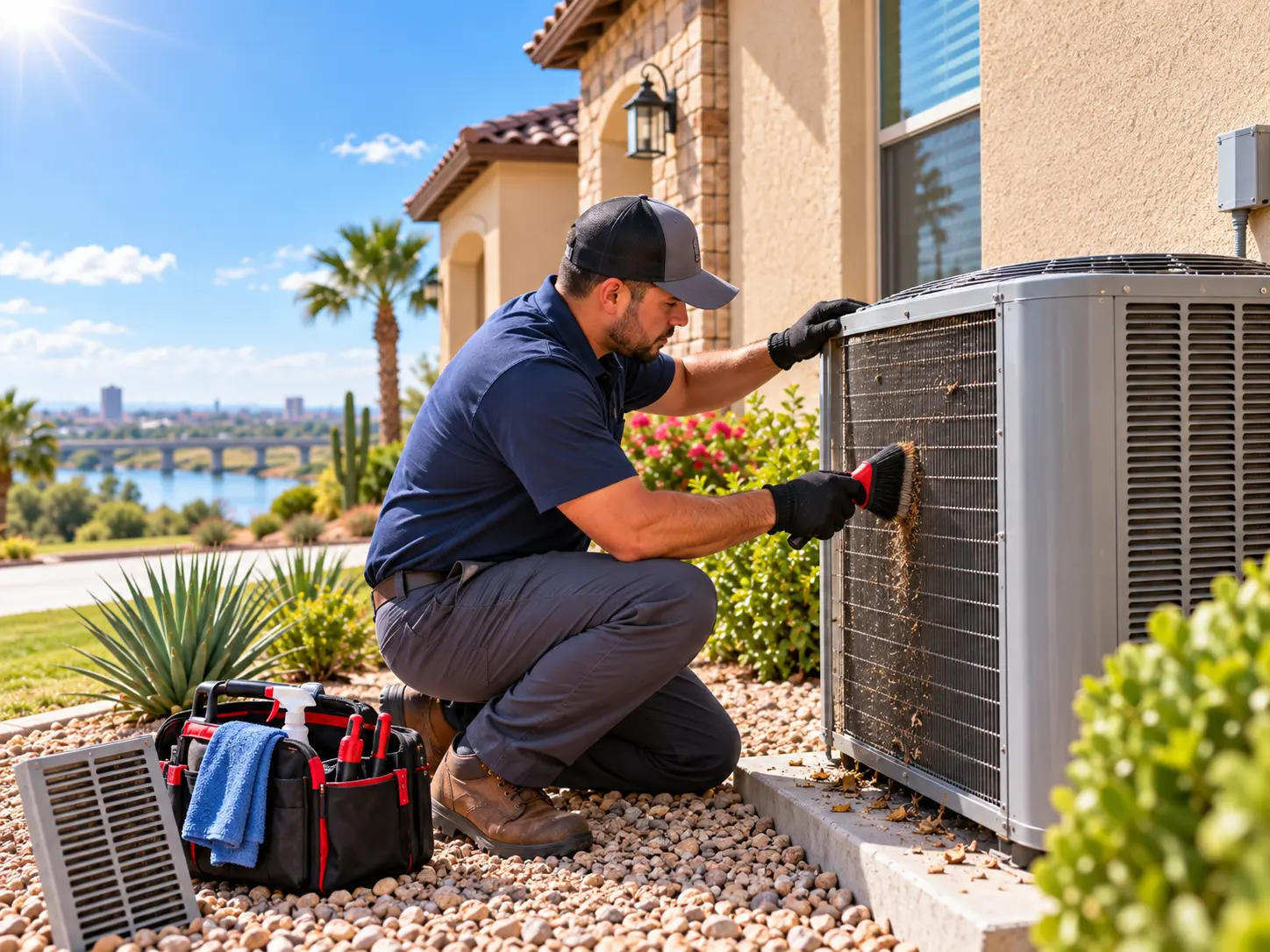
In a climate with a long cooling season, air conditioning equipment accumulates run hours quickly. That makes routine care more consequential here than in regions where systems idle for much of the year.
This page explains what maintenance typically covers, which tasks belong to the homeowner, and how to tell whether your system is drifting before it stops cooling entirely.
What routine maintenance typically covers
The point of the list is not thoroughness for its own sake. Each item corresponds to a common failure path: restriction leads to icing, dirty coils lead to high pressures and lost capacity, clogged drains lead to water damage or a system locked out by its float switch, and weak electrical components lead to no-start calls on the hottest afternoon.
- Filter condition and correct fit, including checking for bypass around the filter frame.
- Condenser coil cleanliness and clearance around the outdoor unit.
- Evaporator coil condition where it is accessible.
- Blower operation, wheel cleanliness and airflow observations.
- Condensate drain flow, pan condition and float switch function.
- Electrical inspection: connections, contactor condition, capacitor readings.
- Refrigerant-circuit performance indicators such as temperature split and operating behavior.
- Thermostat operation, settings and control response.
What homeowners can do between visits
These tasks stay outside the equipment cabinet. Anything involving electrical covers, capacitors, refrigerant lines or safety devices belongs to a technician.
- Check the filter monthly during heavy cooling months and replace it when it looks loaded.
- Keep two feet of clearance around the outdoor unit — trim shrubs and clear grass clippings and leaves.
- Rinse visible debris off the outside of the condenser with a gentle garden hose stream, with the power off at the disconnect.
- Keep supply registers and return grilles open and unobstructed.
- Look under and around the indoor unit occasionally for signs of water.
- Note changes in run time, noise or cooling performance and mention them when you request service.
Signs your system is drifting
Systems rarely fail without warning. The early signals are usually subtle: run times that stretch longer than last year, a house that takes noticeably longer to recover in the evening, airflow that feels weaker at familiar registers, a faint musty smell when the blower starts, or occasional water spots near the indoor unit.
Catching those signals is valuable because the corresponding repairs are usually small. A drain cleared in May is inexpensive; the same drain overflowing into a ceiling in August is not.
Timing maintenance around the Laredo season
The practical window is before sustained heat arrives — late winter through spring. Checking a system in that window means airflow, coil condition and electrical health are addressed before the equipment is running most of the day.
If your system was not checked before summer, it is still worth doing. A midsummer check often finds a coil or filter restriction that is quietly costing capacity, and correcting it can improve performance immediately.
Before you call
Safe checks and clear limits
A few quick observations often speed up a service request. Everything below stays outside the equipment cabinet.
Safe checks a homeowner can make
- Confirm the thermostat is set to COOL and the fan setting is on AUTO or ON.
- Set the thermostat several degrees below the current indoor temperature.
- Look at an accessible air filter and replace it if it is visibly loaded with dust.
- Check the breaker for the air conditioner once, and leave it alone if it trips again.
- Replace thermostat batteries if the model uses them and the screen is dim or blank.
- Make sure supply registers and return grilles are open and not blocked by furniture.
- Look for visible water around the indoor unit or in the drain pan.
- Listen for unusual sounds and note when they happen — startup, running, or shutdown.
Leave these to a professional
- Do not open energized equipment or remove electrical covers.
- Do not handle capacitors — they can hold a charge after power is removed.
- Do not bypass, jump or defeat safety devices such as float switches or limits.
- Do not loosen, tap or otherwise manipulate refrigerant lines or service ports.
- Do not repeatedly reset a breaker that keeps tripping.
If a symptom involves burning smells, smoke, sparking or standing water near electrical equipment, turn the system off at the thermostat and breaker and request service.
Questions & answers
Frequently Asked Questions
- How often should I change my AC filter in Laredo?
- During heavy cooling months, check monthly rather than following the package interval. Actual life depends on filter thickness, dust levels, pets, construction nearby and how many hours the system runs. A one-inch filter in a home running the AC most of the day can load up in four to six weeks, while a four-inch media filter may last several months. Replace based on how it looks, not the calendar alone.
- Does AC maintenance actually prevent breakdowns?
- It reduces the most common causes. Restricted filters, dirty coils and clogged drains are behind a large share of no-cool calls, and all three are maintenance items. Maintenance cannot prevent every failure — electrical components and motors can fail without warning — but it removes the failure modes that build up gradually and are entirely predictable.
- Can I clean the outdoor unit myself?
- You can safely clear leaves, grass and debris from around the unit and rinse the outside of the coil with a gentle hose stream after shutting power off at the disconnect. Do not use a pressure washer, do not remove electrical covers, and do not bend or probe the fins. Deep cleaning, chemical coil cleaning and any work inside the cabinet should be left to a technician.
- What is the difference between maintenance and a tune-up?
- In practice the terms overlap. On this site, maintenance describes the ongoing care routine — filters, coils, drains, inspection — while the tune-up page focuses on a seasonal visit that includes performance measurement and adjustment. Either way, what matters is the actual scope of work performed, so it is reasonable to ask what a visit includes.
- Is maintenance worth it on an older system?
- Often yes, for a different reason. On older equipment, maintenance is less about extending life indefinitely and more about keeping the system running reliably through the season and giving you information for planning. A technician can tell you what condition the coils, electrical components and refrigerant circuit are in, which helps you decide whether to keep repairing or begin comparing replacement.
Need Help With Your AC?
Describe what your air conditioner is doing and request service for your Laredo-area property.
(956) 663-3737