Thermostat Troubleshooting for Air Conditioners
Because the thermostat starts and stops everything, thermostat problems imitate equipment problems. This guide walks through each symptom, the safe checks that belong to a homeowner, and where the line is.
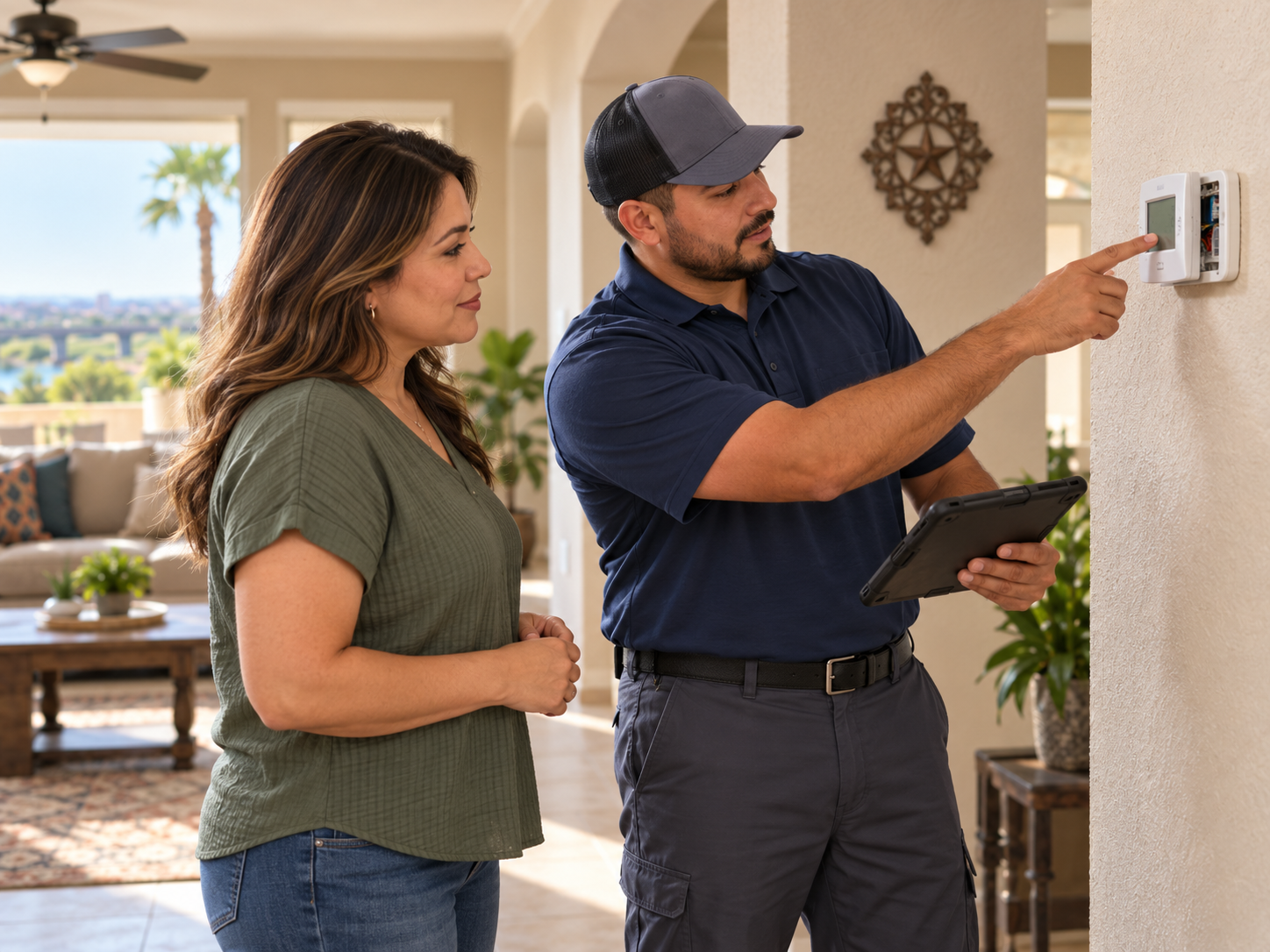
A useful mental model: the thermostat is a switch that needs low-voltage power supplied from the equipment. If that power is interrupted anywhere — a blown control fuse, a tripped float switch, a failed transformer — the thermostat goes dark or stops controlling, even though the thermostat itself is fine.
That is why replacing a thermostat sometimes does not solve the complaint, and why the control circuit gets tested before parts get replaced.
Blank or unresponsive display
Do not remove the thermostat from the wall to probe or jumper wires. Shorting the wrong low-voltage terminals can damage a control board or transformer.
- SAFE CHECK: If the model uses batteries, replace them with fresh ones.
- SAFE CHECK: Confirm the breaker for the air conditioner is on — check it once.
- SAFE CHECK: Look for a service switch near the indoor unit that may have been left off.
- SAFE CHECK: Look for water in or near the indoor unit; a tripped float switch cuts the cooling call.
- PROFESSIONAL: Control transformer output, blown low-voltage fuse, control board fault, wiring damage.
System will not respond to the setpoint
- SAFE CHECK: Confirm the mode is COOL — not HEAT, OFF, or fan-only.
- SAFE CHECK: Set the target several degrees below the current room reading.
- SAFE CHECK: Look for an active schedule, hold or vacation setting overriding your input.
- SAFE CHECK: On smart thermostats, confirm no eco or away mode is engaged.
- PROFESSIONAL: Control wiring continuity, contactor operation, equipment lockout, board response.
Temperature reading looks wrong
Placement explains most discrepancies. A thermostat reading three degrees off because of afternoon sun will cycle the system in ways that make the rest of the house uncomfortable.
- SAFE CHECK: Note whether the thermostat is in sunlight, near a supply register, on an exterior wall, or near a lamp or electronics.
- SAFE CHECK: Compare against a thermometer placed in the middle of the room at the same height.
- PROFESSIONAL: Sensor calibration or drift, relocation recommendations, remote sensor options.
Short cycling
- SAFE CHECK: Replace a loaded filter — restriction is a common cause of early shutdown.
- SAFE CHECK: Note the pattern: minutes running, minutes off, and whether it changes with outdoor temperature.
- SAFE CHECK: Check whether the thermostat is exposed to a draft or direct supply air.
- PROFESSIONAL: Cycle-rate configuration, sensor issues, control faults, pressure-related protection, airflow measurement.
Fan runs constantly or will not run
- SAFE CHECK: Set the fan to AUTO instead of ON if the blower never stops.
- SAFE CHECK: Confirm circulation or fan-schedule features are not enabled on a smart thermostat.
- PROFESSIONAL: Stuck relay, control wiring fault, blower motor or module problem.
Smart thermostat connectivity and power issues
Many smart thermostats need a common conductor to stay continuously powered. Without one, some models scavenge power in ways that cause intermittent behavior — rebooting when the system cycles, losing connection, or reporting odd errors.
If a smart thermostat has behaved erratically since installation, wiring is the first thing to verify. That is a technician check, not a network problem.
- SAFE CHECK: Verify your Wi-Fi network is working and the thermostat is in range.
- SAFE CHECK: Restart the thermostat through its own menu if it offers that option.
- PROFESSIONAL: Verifying a common conductor is present and correctly connected, transformer capacity, wiring corrections.
What never belongs on a homeowner list
- Removing thermostat wires from terminals or jumpering terminals together.
- Opening equipment electrical compartments to test control voltage.
- Bypassing a float switch or any safety device to restore cooling.
- Repeatedly resetting a breaker that keeps tripping.
Questions & answers
Frequently Asked Questions
- Why is my thermostat blank?
- On battery-powered models, dead batteries are the usual answer. On thermostats powered by the equipment, a blank display normally means low-voltage power was interrupted — a blown control fuse, a failed transformer, a float switch tripped by a clogged condensate drain, or a service switch left off. Replace batteries if applicable; beyond that the control circuit needs testing.
- Can a bad thermostat make my AC blow warm air?
- It can, in a specific way: if the thermostat is set to fan-only or is calling for the blower without a cooling command, air moves without being cooled. A wiring or control fault can produce the same result. Confirm the mode is COOL and the setpoint is below room temperature first — that resolves this more often than people expect.
- Why does my AC cycle on and off so quickly?
- Common causes include restricted airflow, a thermostat located where it senses unrepresentative temperature such as near a supply register or in sunlight, cycle-rate settings, control or sensor faults, and pressure-related protection tripping and resetting. Note the actual timing before requesting service — how long it runs and how long it stays off is genuinely useful diagnostic information.
- Do I need to replace my thermostat if it is old?
- Not because of age alone. If it controls the system reliably and reads accurately, it is doing its job. Replacement makes sense when it fails, reads inaccurately, lacks capability your equipment needs such as multi-stage control, or when you want scheduling and run-time visibility. Compatibility with your equipment and wiring matters more than features.
- Should I set a schedule or hold one temperature?
- Either can work. In a hot climate, deep setbacks during the day can mean the system spends the evening trying to recover, which sometimes negates the savings and leaves the house uncomfortable. Moderate setbacks of a few degrees usually work better than large ones. If the system struggles to recover after a setback, reduce the setback rather than fighting it.
Need Help With Your AC?
Describe what your air conditioner is doing and request service for your Laredo-area property.
(956) 663-3737