Air Conditioner Repair in Laredo, TX
This page looks at air conditioner repair from the equipment side: the individual parts of a residential system, the symptoms each one tends to produce when it fails, and what evaluation involves. If you would rather start from a symptom, the AC not cooling page is the better entry point.
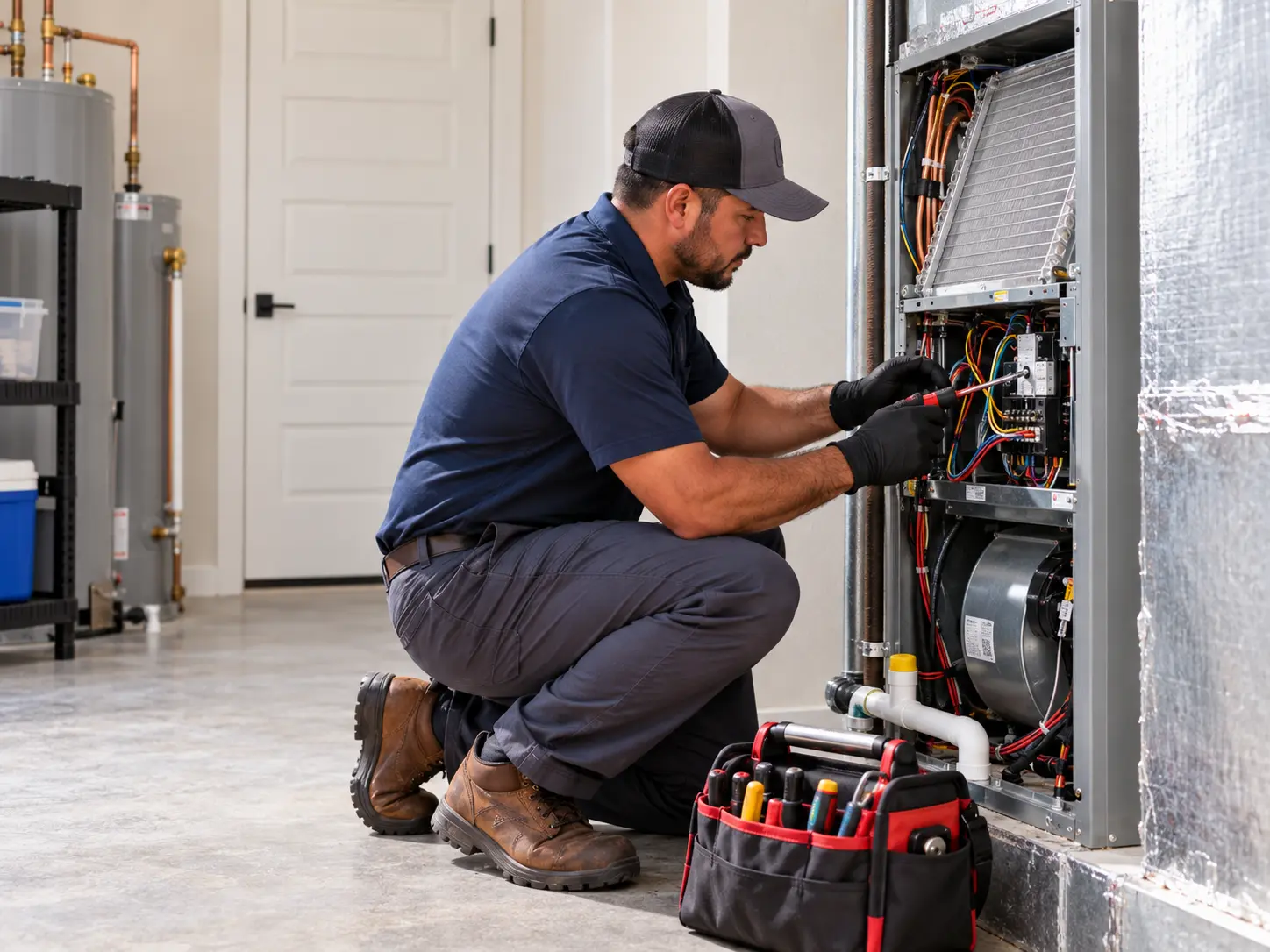
A residential air conditioner is a small number of subsystems working together: an outdoor condensing unit, an indoor coil and blower, a refrigerant circuit connecting them, a low-voltage control circuit, and a condensate drainage path. Nearly every repair traces back to one of those five.
Understanding which component produces which symptom makes service conversations much clearer. It also helps you recognize the difference between a wear item that commonly needs replacement and a larger issue where repair and replacement deserve comparison.
Components that commonly need attention
- Run capacitor
- Supports the compressor and condenser fan motors. Weak or failed capacitors often show up as a humming outdoor unit, a fan that will not start, or a system that trips a breaker on startup.
- Contactor
- The relay that sends line voltage to the outdoor unit. Pitted or stuck contacts can cause no-start conditions or a unit that runs when it should not.
- Condenser fan motor
- Pulls air across the outdoor coil. When it fails, the compressor may run briefly, then shut down on high pressure or overheat protection.
- Blower motor
- Moves indoor air across the evaporator coil. Symptoms include weak or absent airflow, unusual noise, or a system that ices up.
- Evaporator coil
- Absorbs heat from indoor air. Fouling reduces capacity; a leak in the coil reduces cooling and often causes gradual performance decline.
- Condenser coil
- Rejects heat outdoors. Dust, grass and debris insulate it, raising pressures and reducing cooling — a very common issue locally.
- Control board
- Coordinates blower operation, delays and safeties. Faults can look like intermittent no-start or erratic cycling.
- Float switch and drain
- Handles condensate. A clogged drain trips the switch and stops cooling to prevent water damage.
Symptoms mapped to likely areas
| Symptom | Areas commonly involved |
|---|---|
| Outdoor unit hums but does not start | Capacitor, contactor, motor winding |
| Breaker trips when cooling starts | Electrical fault, motor, capacitor, wiring |
| Weak airflow indoors | Filter, blower assembly, duct restriction, coil fouling |
| Water at the indoor unit | Condensate drain, pan, float switch, coil icing |
| Cooling gradually got worse over seasons | Coil fouling, refrigerant circuit, duct leakage |
| Loud metallic or grinding noise | Fan blade contact, motor bearings, compressor |
| System runs constantly without satisfying | Capacity limits, coil condition, refrigerant circuit, load |
What an evaluation usually includes
A typical residential evaluation starts with the complaint and the equipment's behavior, then moves to measurements. Expect a technician to verify the thermostat call, check voltage and control signals, inspect the filter and coils, observe blower and condenser fan operation, measure temperature split across the indoor coil, and check the condensate path.
Where the symptoms point to the sealed system, gauges and temperature readings are used to evaluate the refrigerant circuit. That step is deliberate rather than automatic — adding refrigerant to a system that is low because of a leak is a temporary measure, and the leak itself needs to be identified.
Repair items versus bigger decisions
Many repairs are component-level and straightforward: a capacitor, a contactor, a fan motor, a float switch, a clogged drain, a failed thermostat. These restore normal operation without changing the system's fundamentals.
Other findings change the conversation — a leaking evaporator coil on an older system, a failed compressor, or an aging system using an obsolete refrigerant. In those cases the useful step is comparing repair against replacement rather than assuming either one. The repair-or-replace page walks through the factors involved without pushing a conclusion.
Before you call
Safe checks and clear limits
A few quick observations often speed up a service request. Everything below stays outside the equipment cabinet.
Safe checks a homeowner can make
- Confirm the thermostat is set to COOL and the fan setting is on AUTO or ON.
- Set the thermostat several degrees below the current indoor temperature.
- Look at an accessible air filter and replace it if it is visibly loaded with dust.
- Check the breaker for the air conditioner once, and leave it alone if it trips again.
- Replace thermostat batteries if the model uses them and the screen is dim or blank.
- Make sure supply registers and return grilles are open and not blocked by furniture.
- Look for visible water around the indoor unit or in the drain pan.
- Listen for unusual sounds and note when they happen — startup, running, or shutdown.
Leave these to a professional
- Do not open energized equipment or remove electrical covers.
- Do not handle capacitors — they can hold a charge after power is removed.
- Do not bypass, jump or defeat safety devices such as float switches or limits.
- Do not loosen, tap or otherwise manipulate refrigerant lines or service ports.
- Do not repeatedly reset a breaker that keeps tripping.
If a symptom involves burning smells, smoke, sparking or standing water near electrical equipment, turn the system off at the thermostat and breaker and request service.
Questions & answers
Frequently Asked Questions
- What is the most common air conditioner repair?
- Across residential systems, electrical components and airflow items account for a large share of service calls — capacitors, contactors, fan motors, clogged condensate drains and restricted filters or coils. These are wear-and-maintenance items rather than design failures, which is why routine attention to filters, coil cleanliness and drains reduces how often they interrupt cooling.
- How do I know whether the problem is indoors or outdoors?
- Listen and feel. If the indoor blower runs but the outdoor unit is silent during a cooling call, attention starts outdoors or in the control circuit. If the outdoor unit runs but indoor airflow is weak or absent, the indoor blower and duct system come first. If both run and cooling is still poor, the refrigerant circuit and coil condition become the focus.
- Does refrigerant get used up over time?
- No. A sealed refrigerant circuit does not consume refrigerant. If a system is low, refrigerant escaped somewhere — a fitting, a coil, a line set or a service port. That is why simply adding refrigerant is a short-term measure. Locating and addressing the leak is what makes the repair last, and a technician can advise whether that is practical for a given system.
- How long do air conditioner parts usually last?
- It varies widely with run hours, maintenance and conditions. Capacitors and contactors are relatively short-lived wear items. Motors often last many years but are affected by heat and dirt. Coils can last the life of the equipment or fail early from corrosion or damage. In a climate with long cooling seasons like Laredo's, accumulated run hours tend to be higher than in milder regions for equipment of the same age.
- Can I replace a part myself?
- Filters and thermostat batteries are homeowner items. Beyond that, air conditioning repair involves line voltage, capacitors that can hold a charge after power is removed, and a pressurized refrigerant circuit. Those are genuine hazards, and refrigerant handling is regulated. Stick to filters, registers, breaker checks and thermostat settings, and let a technician open the equipment.
- What information should I have ready when I call?
- The symptom in plain terms, whether the indoor and outdoor units are running, when the problem started, whether it is constant or intermittent, the equipment type, a rough age, and anything unusual you noticed such as noises, smells, ice or water. If you know the brand or have the model and serial number handy, that helps too.
Need Help With Your AC?
Describe what your air conditioner is doing and request service for your Laredo-area property.
(956) 663-3737