Thermostat Repair in Laredo, TX
A thermostat is the control point for the entire cooling system, so thermostat trouble often looks like equipment trouble. A blank display, an inaccurate reading or a lost call for cooling can leave a perfectly healthy air conditioner sitting idle.
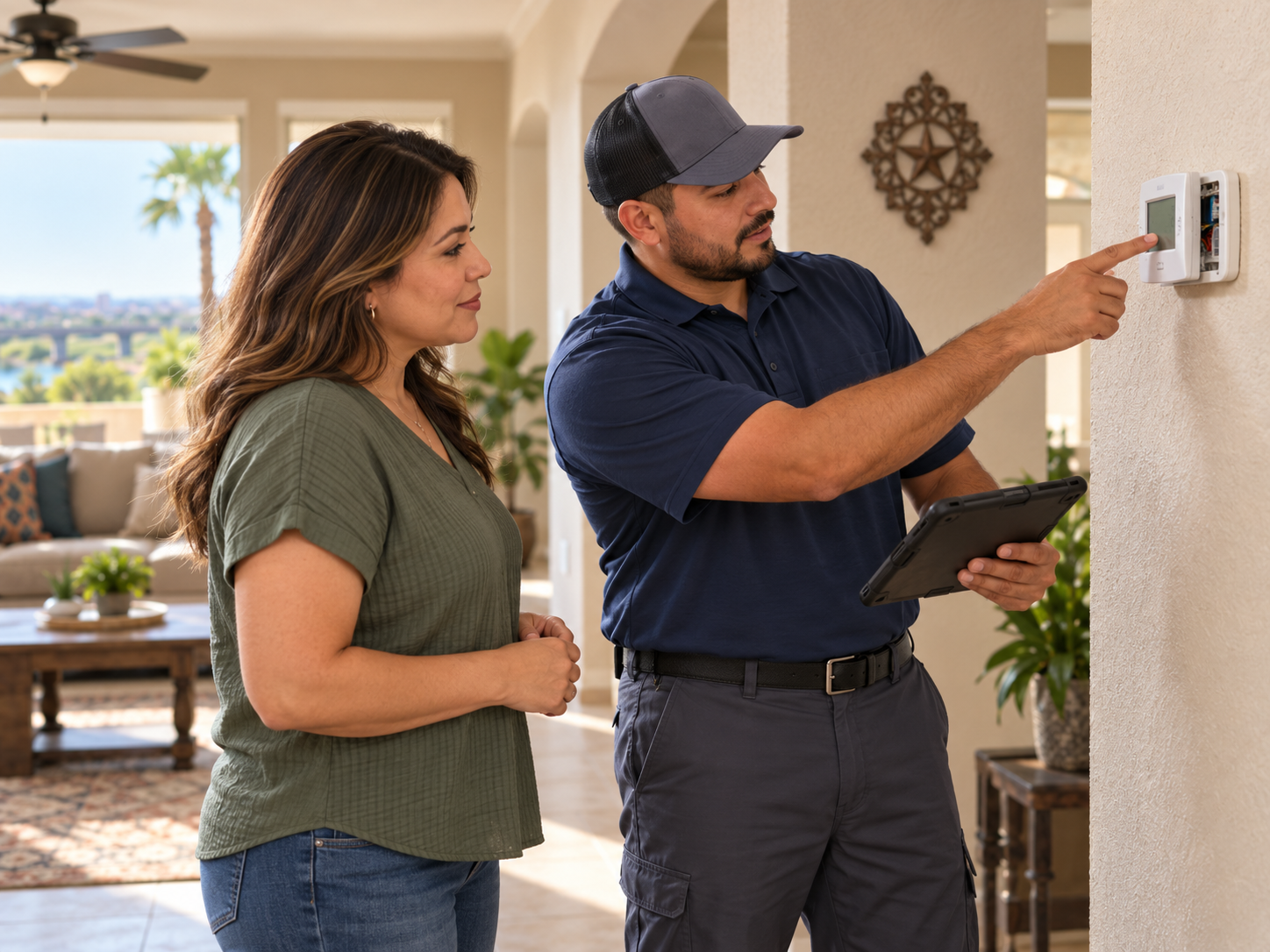
Some thermostat complaints are genuinely thermostat problems. Others are the thermostat correctly reporting that something upstream — a low-voltage fuse, a tripped float switch, a transformer or a control board — has interrupted the circuit.
This page separates the two, covers the safe checks worth making first, and explains what a technician evaluates when the control circuit is involved.
Common thermostat symptoms
- Blank or dim display
- Often batteries on models that use them, or loss of low-voltage power from a blown fuse, tripped float switch or transformer issue.
- System does not respond to setpoint
- Could be wiring, a failed thermostat, a configuration setting, or an interrupted control circuit at the equipment.
- Room temperature reading looks wrong
- Placement matters — sun exposure, a nearby supply register, an exterior wall or a lamp can all skew readings. Sensor drift also occurs.
- Short cycling
- Can result from thermostat location, cycle-rate configuration, or a sensing problem — but also from airflow and equipment issues.
- Fan runs constantly
- Often the fan setting is on ON rather than AUTO. It can also indicate a stuck relay or control fault.
- Smart thermostat connectivity loss
- Usually network or power related, though wiring without a common conductor is a frequent cause of intermittent behavior.
Safe checks before requesting service
Do not remove the thermostat from the wall to probe wires, and do not jumper terminals together. Low-voltage wiring connects to equipment controls, and shorting the wrong pair can damage a board or a transformer.
- Confirm the mode is COOL, not HEAT, OFF or fan-only.
- Set the target temperature several degrees below the current room reading.
- Replace batteries if the model uses them.
- Check whether any schedule or hold setting is overriding what you expect.
- Check the breaker for the air conditioner once.
- Look for water in or near the indoor unit — a tripped float switch can make a system look unresponsive.
When the problem is upstream of the thermostat
A thermostat needs low-voltage power supplied through the equipment. If a control transformer fails, a board fuse blows, or a safety device such as a float switch or high-limit opens the circuit, the thermostat can go blank or stop controlling even though the thermostat itself is fine.
This is why replacing a thermostat sometimes does not fix the complaint. A technician traces the control circuit — transformer output, fuse condition, safety devices and board response — before concluding the thermostat is at fault.
Replacement and compatibility
When a thermostat does need replacing, compatibility matters more than features. Equipment type — single-stage, multi-stage, heat pump with auxiliary heat, communicating systems — determines which thermostats will work correctly. So does the available wiring, especially whether a common conductor is present for continuously powered models.
A mismatch can produce subtle problems: staging that never engages, a heat pump running auxiliary heat unnecessarily, or a smart thermostat that reboots when the system cycles. Confirming compatibility up front avoids chasing those symptoms later.
Before you call
Safe checks and clear limits
A few quick observations often speed up a service request. Everything below stays outside the equipment cabinet.
Safe checks a homeowner can make
- Confirm the thermostat is set to COOL and the fan setting is on AUTO or ON.
- Set the thermostat several degrees below the current indoor temperature.
- Look at an accessible air filter and replace it if it is visibly loaded with dust.
- Check the breaker for the air conditioner once, and leave it alone if it trips again.
- Replace thermostat batteries if the model uses them and the screen is dim or blank.
- Make sure supply registers and return grilles are open and not blocked by furniture.
- Look for visible water around the indoor unit or in the drain pan.
- Listen for unusual sounds and note when they happen — startup, running, or shutdown.
Leave these to a professional
- Do not open energized equipment or remove electrical covers.
- Do not handle capacitors — they can hold a charge after power is removed.
- Do not bypass, jump or defeat safety devices such as float switches or limits.
- Do not loosen, tap or otherwise manipulate refrigerant lines or service ports.
- Do not repeatedly reset a breaker that keeps tripping.
If a symptom involves burning smells, smoke, sparking or standing water near electrical equipment, turn the system off at the thermostat and breaker and request service.
Questions & answers
Frequently Asked Questions
- Why is my thermostat screen blank?
- Two main possibilities. On battery-powered models, dead batteries are the most common cause. On models powered from the equipment, a blank screen usually means low-voltage power was interrupted — a blown control fuse, a failed transformer, a tripped float switch on a clogged condensate drain, or a service switch left off. Replacing batteries is a reasonable first step; beyond that the control circuit needs testing.
- Can thermostat problems make an AC stop working?
- Yes. The thermostat initiates the cooling call, so a failed thermostat, a wiring fault or a configuration error can leave the equipment idle even though nothing is wrong with it. This is worth knowing because a system that appears dead is not necessarily facing an expensive repair — the control side is always checked first for exactly this reason.
- Why does my thermostat show a different temperature than a room thermometer?
- Placement explains most discrepancies. A thermostat on an exterior wall, in direct sun, near a supply register, above a heat-producing appliance or near a drafty door will read differently from the middle of the room. Sensor drift can also occur on older units. If the reading is consistently off by several degrees, relocation or replacement may be worth discussing.
- Should I upgrade to a smart thermostat?
- It can help with scheduling and visibility into run time, which is useful in a long cooling season. The important caveats are compatibility with your equipment and available wiring — many models want a common conductor for reliable power. A smart thermostat also will not fix airflow, capacity or duct problems, so it is an improvement rather than a solution to comfort complaints.
- Why does my fan run all the time?
- Most often the fan setting is on ON instead of AUTO, which runs the blower continuously regardless of cooling. Switch it to AUTO and see whether the behavior stops. If it continues, a stuck relay, a wiring issue or a control fault could be keeping the blower energized, and that should be evaluated.
Need Help With Your AC?
Describe what your air conditioner is doing and request service for your Laredo-area property.
(956) 663-3737