
Laredo AC Maintenance Guide
Cooling season here is long, so maintenance is less about an annual ritual and more about a rhythm. This guide organizes care by season and separates homeowner tasks from professional work.
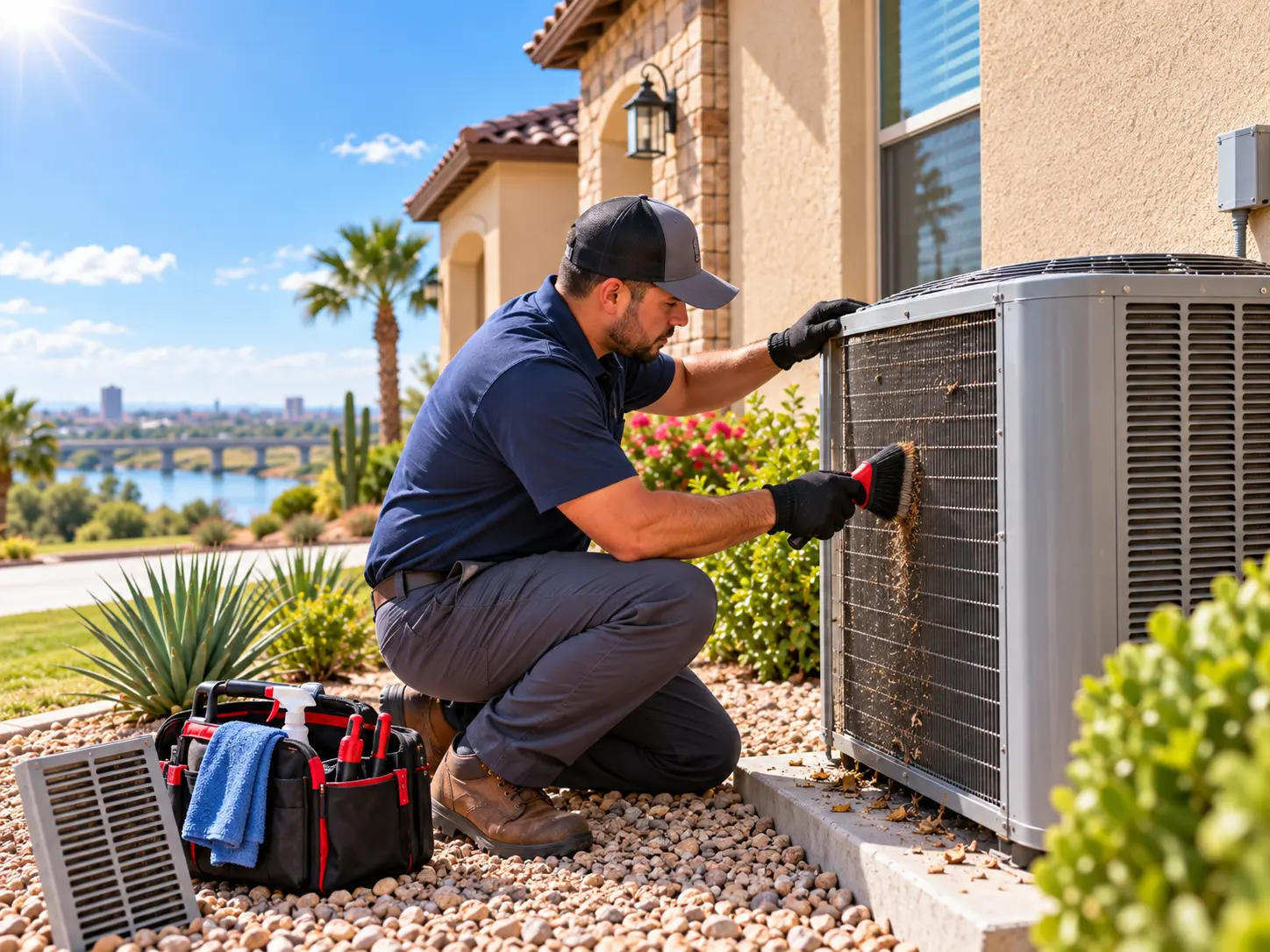
Three things account for most preventable cooling failures: restricted airflow, fouled coils and blocked condensate drains. A maintenance rhythm that stays ahead of those three removes the majority of midsummer emergencies.
None of the homeowner tasks below require opening equipment. Anything inside a cabinet — electrical, refrigerant, safety devices — belongs to a technician.
Late winter and early spring: prepare
Testing early is the highest-value habit on this list. A system that will not start in March is an inconvenience; the same failure in July is an emergency.
- Replace the filter and note the correct size so you can keep spares on hand.
- Clear leaves, seed pods and debris from around and inside the base of the outdoor unit.
- Trim vegetation back to roughly two feet on all sides of the condenser.
- Test cooling on a mild day so problems surface before you need the system.
- Schedule professional attention — coil condition, electrical readings, drain flow, performance measurement.
Through summer: maintain
- Check the filter monthly, and replace it whenever it looks loaded rather than waiting for a date.
- Rinse visible dust off the outdoor coil with a gentle hose stream after cutting power at the disconnect.
- Keep supply registers and return grilles open and unobstructed.
- Glance for water near the indoor unit every few weeks, especially with an attic installation.
- Note changes in run time, airflow strength or noise, and mention them when you request service.
- Close blinds on sun-facing windows during peak afternoon hours to reduce load.
Shoulder months: assess
- Compare this season's run times and comfort with last year's — a decline is information.
- Address any deferred items now, while the system is not running most of the day.
- Check duct insulation and connections where they are safely visible in the attic.
- If the system struggled during peak heat, have airflow, coil condition and capacity evaluated before next summer.
Homeowner tasks versus professional work
| Task | Who |
|---|---|
| Filter replacement | Homeowner |
| Clearing debris and vegetation around the outdoor unit | Homeowner |
| Gentle exterior coil rinse with power off | Homeowner |
| Keeping registers and returns clear | Homeowner |
| Thermostat batteries and settings | Homeowner |
| Electrical testing, capacitor readings, contactor inspection | Professional |
| Chemical coil cleaning and indoor coil access | Professional |
| Condensate line clearing and float switch testing | Professional |
| Refrigerant circuit evaluation | Professional |
| Blower wheel cleaning and duct repair | Professional |
What maintenance cannot fix
Maintenance keeps a properly designed system operating near its potential. It cannot overcome undersized ductwork, inadequate return capacity, equipment that is too small for the load, or a house with major heat-gain issues.
If your system is clean, airflow is good and it still cannot hold temperature during peak afternoons, the next step is a capacity and distribution evaluation rather than more maintenance.
Questions & answers
Frequently Asked Questions
- How often should I change my filter in Laredo?
- Check monthly during cooling season and replace based on appearance. A one-inch filter in a home running the AC most of the day often loads in four to six weeks, and faster in dusty areas or homes with pets. Thicker media filters hold more and can last several months. Replacing on appearance rather than a fixed date is both cheaper and more effective.
- What is the single most important maintenance task?
- Airflow — which in practice means filters and clear returns and registers. Restricted airflow lowers capacity, encourages coil icing and stresses the compressor, and it is entirely preventable. Coil cleanliness on the outdoor unit is a close second, especially in dusty conditions and during peak heat.
- Can I rinse my outdoor unit with a hose?
- Yes, with care. Cut power at the disconnect first, then use a gentle stream from the outside of the coil to rinse dust and debris away. Avoid pressure washers, which bend fins and push debris deeper into the coil. Do not remove electrical covers or spray inside the cabinet.
- Should I cover my outdoor unit?
- Full covers are generally unnecessary here and can trap moisture or invite pests. If debris accumulation is the concern, a mesh top screen that does not restrict the fan discharge is a better option — and it must be removed before the unit runs. Prioritize clearance and cleanliness over covering.
- How do I know if my condensate drain is clogging?
- Early signs include water spots or staining near the indoor unit, a musty smell when the blower starts, or the system shutting off cooling with no other symptom — the last one often means a float switch tripped. If you can safely see the drain outlet outside, water should be dripping steadily during humid weather. No water during heavy cooling is a signal.
Need Help With Your AC?
Describe what your air conditioner is doing and request service for your Laredo-area property.
(956) 663-3737